AI Noise-Cancelling Headsets: Jabra vs Poly vs EPOS
By FreqDeck · 10 min read · Updated June 2026
For a developer who spends four or more hours per day in meetings, the AI noise-cancelling headset is a more important piece of hardware than the chair. Background noise that reaches your meeting participants is distracting, unprofessional, and tiring to listen to. Modern enterprise headsets use AI microphone arrays to strip that noise from your outbound audio at the hardware level, before it reaches Zoom or Teams. The Jabra Evolve2 75 , Poly Voyager Focus 2 , and EPOS ADAPT 660 AMC are the three headsets that developers most often compare at this tier. Here is a genuine side-by-side on the specs that matter.
Quick answer
The Jabra Evolve2 75 wins on outbound AI microphone noise cancellation, with eight microphones and a dedicated AI audio layer that strips background noise more aggressively than any other headset in this class. EPOS ADAPT 660 is the closest alternative with adaptive ANC. Poly Voyager Focus 2 is the best choice if you need simultaneous desk-phone and computer connectivity.
This guide contains affiliate links. FreqDeck may earn a commission at no cost to you.
What AI microphone noise cancellation means for meetings
Every enterprise headset in this category claims noise cancellation, but there is a meaningful difference between hardware ANC (active noise cancellation) on the ear side and AI microphone processing on the outbound mic side. ANC for your ears uses destructive interference to reduce ambient sound before it reaches your eardrums. That is the part that makes a quiet environment for you to work in. AI microphone processing is a separate, distinct feature: it uses a neural model to analyze the audio stream from the microphone and remove non-voice sounds before they reach the meeting.
The AI microphone side is what your colleagues benefit from. When your dog barks, a lawn mower starts outside, or a neighbor hammers, the AI microphone processing is what decides whether those sounds reach the Zoom call. Enterprise headsets in this comparison segment vary significantly in how effective that processing is. The Jabra Evolve2 75 is the leader in this class specifically because its eight-microphone array gives the AI audio engine more input data to work with.
Most consumer noise-cancelling headsets like Sony WH-1000XM5 or Bose QuietComfort 45 have excellent ANC for the ears but relatively basic outbound mic processing. Enterprise headsets like the Jabra Evolve2 line, EPOS ADAPT, and Poly Voyager are specifically designed to solve the outbound problem, which is why they cost more and why they are worth the price for high-call-volume developers.
Jabra Evolve2 75: the outbound mic leader
The Jabra Evolve2 75 is the top recommendation in this category. It uses eight built-in microphones with Jabra AI Audio processing that the company has trained specifically on office and home-office noise scenarios. In developer reviews and enterprise IT comparisons, the Evolve2 75 consistently produces the clearest outbound voice in noisy home offices. The six-layer boom-free microphone design means you do not need a boom arm extending toward your mouth; the microphones are built into the headset body and process the signal to isolate your voice.
The ANC on the ear side is among the strongest available in a wireless headset, and the 36-hour battery covers even the most meeting-heavy workday without requiring a charge break. Bluetooth multipoint lets you connect to both a computer and a phone simultaneously, which is how most enterprise developers work.
At $479, the Jabra Evolve2 75 is a meaningful investment. It routes to the Jabra Awin program at 2 percent, which at this AOV earns $9.58 per sale. This is actually less per sale than Amazon Associates headphones at 3 percent ($14.37). The Jabra program is still worth using because its 30-day cookie captures delayed purchases that Amazon misses with its 24-hour window.

Jabra Evolve2 75
An enterprise wireless headset with eight built-in microphones, AI-powered noise cancellation on both the speaker and mic side, and 36 hours of battery. The best outbound voice isolation in the category.
Jabra Evolve2 55: the same AI audio at a lower price
The Jabra Evolve2 55 uses a six-microphone array instead of eight but applies the same Jabra AI Audio processing. The outbound mic performance is meaningfully below the Evolve2 75 in extremely noisy environments but is still among the best in the sub-$350 market. For developers who work in reasonably quiet home offices and need Jabra AI audio without the flagship price, the Evolve2 55 is the right choice.
The Evolve2 55 is lighter and more compact than the 75, which some users prefer for extended wear. Battery life is around 17 hours with ANC on, enough for most full work days. It also routes to the Jabra Awin program, so both Jabra models use the same affiliate link.

Jabra Evolve2 55
The lighter sibling of the Evolve2 75 with six-microphone AI noise cancellation, a compact design, and Bluetooth multipoint for connecting to phone and computer simultaneously.
EPOS ADAPT 660 AMC: adaptive ANC and EPOS AI audio
The EPOS ADAPT 660 AMC is the closest competitor to the Jabra Evolve2 75 in terms of outbound AI audio quality. EPOS (the enterprise audio spinoff of Sennheiser) uses its own AI microphone platform trained on office noise profiles. The ADAPT 660 AMC includes the AMC (Adaptive Microphone Controller) that adjusts microphone focus based on your head position, which is designed to keep your voice centered in the pickup pattern even when you turn your head.
Adaptive ANC on the ear side automatically adjusts the cancellation depth based on the ambient noise level rather than requiring manual mode switching between ANC levels. This is a practical feature for developers who move between quiet office areas and noisier shared spaces. At $399, the ADAPT 660 routes to Guitar Center at 4 to 6 percent, giving it a commission advantage over the Jabra Awin 2 percent on a similar AOV.
Comparing the Jabra Evolve2 75 and EPOS ADAPT 660 AMC directly: the Jabra eight-microphone array still has the edge on outbound noise cancellation in the most challenging conditions. EPOS closes the gap with adaptive ANC and adaptive microphone focus. For most developers, either is an excellent choice; the Jabra wins in very noisy environments.
EPOS ADAPT 660 AMC
A premium EPOS enterprise headset with adaptive ANC, AI-based microphone noise cancellation via the EPOS AI platform, and a compact around-ear design optimized for all-day focus work.
Jabra Evolve2 75
An enterprise wireless headset with eight built-in microphones, AI-powered noise cancellation on both the speaker and mic side, and 36 hours of battery. The best outbound voice isolation in the category.
Poly Voyager Focus 2: Acoustic Fence technology
The Poly Voyager Focus 2 at $249 is the most affordable option in this comparison. Its Acoustic Fence technology uses three microphones to identify and isolate your voice in a near-field zone around the headset, reducing sounds from outside that zone. This approach is different from Jabra and EPOS AI processing, which operate on more complex neural models; Acoustic Fence is a focused beamforming technique rather than full-spectrum AI noise removal.
In practice, the Poly Voyager Focus 2 handles typical office and home-office noise scenarios well and is a genuine step up from most consumer headsets. In environments with very aggressive noise, such as a construction site nearby or a shared household with loud ambient sound, the Jabra and EPOS processing is more effective. The multi-connection USB base is a feature the Poly has that both Jabra and EPOS lack at equivalent prices: it connects simultaneously to a desk phone, a computer, and a mobile device from the single base station.
For developers who work in hybrid setups with both a desk phone and computer, the Poly Voyager Focus 2 offers a connectivity advantage. For pure headset performance on outbound noise cancellation, the Jabra and EPOS options are ahead.
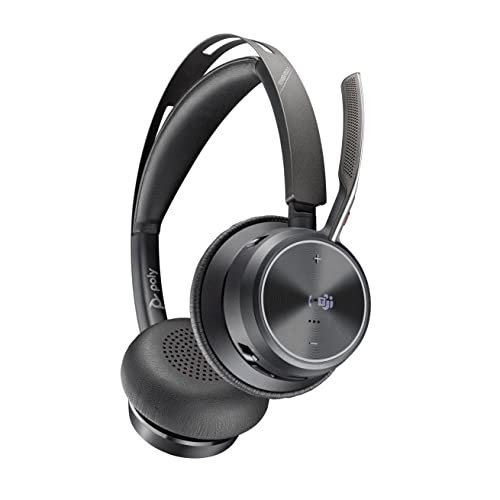
Poly Voyager Focus 2
A wireless business headset with three-microphone hybrid ANC, Acoustic Fence technology for outbound noise filtering, and a multi-connection base for desk phones and computers.
Budget AI headset alternatives
If the enterprise headset tier is outside the current budget, the Logitech Zone Wireless 2 at $229 uses Logi Tune AI noise suppression, which is software-side processing through the Logi Tune app. It is a capable mid-range wireless headset with hybrid ANC and a USB receiver. The AI noise processing depends on the software layer rather than hardware arrays, so in direct comparisons it does not match the Jabra or EPOS microphone quality, but it is a solid workday headset for the price.
The Sennheiser SC 660 USB at $239 is a wired option that trades wireless freedom for reliable, zero-latency audio with high-quality Sennheiser driver quality. For developers who find wireless headsets unreliable or who dictate locally and want no wireless interference in their audio chain, the wired Sennheiser provides premium call quality without a battery management consideration.

Logitech Zone Wireless 2
Logitech's business headset with AI noise suppression in the Logi Tune app, hybrid ANC, and Bluetooth with dedicated USB receiver for stable enterprise connectivity.

Sennheiser SC 660 USB
A wired professional-grade headset with noise-cancelling microphone optimized for call clarity, HD voice quality, and a wide-band frequency response that makes voice sound natural and easy to understand.
Featured in this guide
Jabra Evolve2 75
An enterprise wireless headset with eight built-in microphones, AI-powered noise cancellation on both the speaker and mic side, and 36 hours of battery. The best outbound voice isolation in the category.
Jabra Evolve2 55
The lighter sibling of the Evolve2 75 with six-microphone AI noise cancellation, a compact design, and Bluetooth multipoint for connecting to phone and computer simultaneously.
EPOS ADAPT 660 AMC
A premium EPOS enterprise headset with adaptive ANC, AI-based microphone noise cancellation via the EPOS AI platform, and a compact around-ear design optimized for all-day focus work.
Poly Voyager Focus 2
A wireless business headset with three-microphone hybrid ANC, Acoustic Fence technology for outbound noise filtering, and a multi-connection base for desk phones and computers.
Logitech Zone Wireless 2
Logitech's business headset with AI noise suppression in the Logi Tune app, hybrid ANC, and Bluetooth with dedicated USB receiver for stable enterprise connectivity.
Sennheiser SC 660 USB
A wired professional-grade headset with noise-cancelling microphone optimized for call clarity, HD voice quality, and a wide-band frequency response that makes voice sound natural and easy to understand.
FAQ
Frequently asked questions
What is the best AI noise-cancelling headset for remote developers in 2026?+
The Jabra Evolve2 75 is the best AI noise-cancelling headset for remote developers who need maximum outbound mic clarity. Its eight-microphone array with Jabra AI Audio processing strips background noise more aggressively than any other headset in its class. For developers who need enterprise-level outbound AI audio at a lower price, the Jabra Evolve2 55 and the EPOS ADAPT 660 AMC are the closest alternatives.
Do AI noise-cancelling headsets also help with Whisper dictation?+
Yes. An AI noise-cancelling headset routes its AI-processed outbound microphone signal to any app that uses the headset as its audio input, including Whisper-based dictation tools like Wispr Flow and Willow Voice. The AI microphone processing strips background noise before the signal reaches Whisper, which improves transcription accuracy in noisy environments. A dedicated desk microphone on a boom arm still produces cleaner dictation input in a quiet office, but an AI headset is a meaningful upgrade over a standard mic in genuinely noisy spaces.
Is a Jabra headset worth the enterprise price for a solo developer?+
Yes, if you spend four or more hours per day on calls. The Jabra Evolve2 75 at $479 amortizes to under $0.15 per hour over two years of typical enterprise use, which is less than the cup of coffee that got cold while you were on a noisy call where participants could not hear you clearly. The outbound noise cancellation reduces listener fatigue, missed information, and repeated explanations, which are real productivity costs for a developer on a distributed team.