FreqDeck

Best USB Microphones for AI Dictation and Voice Coding

A great USB microphone is the single most important hardware upgrade for anyone using Whisper, Wispr Flow, Willow, or voice-to-code tools like Cursor and Claude Code. The right mic captures your voice cleanly enough that the AI transcription model rarely mishears you, even in a noisy home office. We looked at cardioid pickup pattern, self-noise floor, USB-C versus legacy connectors, and how each mic performs when Whisper or a similar model is transcribing in real time. Price range runs from $40 budget picks to $250 prosumer options.

Quick answer

The Rode PodMic USB is the best USB microphone for AI dictation and voice coding. Its tight cardioid pattern and built-in preamp reject ambient room noise better than most mics at this price, and Whisper and Wispr Flow users report high word accuracy in noisy home offices. The onboard headphone output lets you monitor in real time.

FreqDeck may earn a commission from links below, at no cost to you. Last updated June 2026.

Top Pick Rode PodMic USB
4.8 Rode

Rode PodMic USB

A broadcast-grade dynamic mic with both USB-C and XLR outputs, tight cardioid pattern, and a built-in headphone output. The top Whisper and Wispr Flow recommendation in developer communities.

Best for Developers who want the single best voice-coding and dictation microphone and are willing to invest in a top-tier dynamic mic.

Tight cardioid pattern rejects room noise aggressively, boosting Whisper accuracy in typical home officesUSB-C and XLR outputs let you start USB and upgrade to an interface laterBuilt-in 3.5mm headphone jack with zero-latency monitoring No onboard gain control in USB mode; adjust gain in OS audio settings
No. 2 Shure MV7+
4.7 Guitar Center

Shure MV7+

An evolved USB/XLR dynamic mic with onboard touch controls, a backlit EQ panel, and Shure's ShurePlus MOTIV app for real-time voice processing. A credible alternative to the Rode PodMic USB for voice-coding setups.

Best for Developers who want onboard hardware controls and a premium build without going into full broadcast territory.

Onboard touch panel controls gain, monitor mix, and EQ from the mic body without opening an appDynamic capsule rejects background noise well for typical home-office dictation sessionsUSB-C and XLR outputs for flexible routing More expensive than the Rode PodMic USB with a slightly less tight polar pattern
No. 3 Rode NT-USB Mini
4.6 Rode

Rode NT-USB Mini

A compact studio condenser with a tight cardioid pattern, USB-C output, and an integrated pop filter built into the capsule housing. Excellent voice clarity for Whisper and voice-coding workflows.

Best for Developers who want studio-grade condenser clarity on a budget and have a reasonably quiet home office.

Compact studio-condenser sound quality at under $100Integrated pop filter reduces plosive artifacts in dictationUSB-C with magnetic desk stand that also functions as a boom-arm mount Condenser capsule picks up more room noise than the PodMic USB, so benefits from acoustic treatment
No. 4 Elgato Wave:3
4.5 Amazon

Elgato Wave:3

A cardioid condenser with a built-in mix controller, Clipguard technology that auto-switches to a second capsule when your voice peaks, and Elgato's WAVE LINK software for per-app audio routing.

Best for Developers who use Elgato's streaming ecosystem and want tight software integration with their audio chain.

Clipguard dual-capsule design prevents audio clipping when you raise your voice during coding sessionsWAVE LINK software gives granular per-app audio controlCapacitive mute button with LED indicator is useful for quickly muting Wispr Flow Condenser capsule picks up more keyboard and room noise than a dynamic mic
No. 5 Blue Yeti X
4.5 Guitar Center

Blue Yeti X

Logitech's flagship Yeti with a multi-pattern condenser array, onboard gain knob, headphone output, and a smart knob that controls both monitoring and software settings. Popular in developer streaming setups.

Best for Developers who want a premium condenser with onboard controls and flexible polar patterns for mixed use between dictation and meetings.

Four polar patterns including cardioid for voice coding and omnidirectional for pair-programming sessionsOnboard gain, mute, and headphone monitoring controls on the mic bodyWide frequency response and high sensitivity capture voice detail clearly Large form factor takes significant desk space without a boom arm
No. 6 Audio-Technica ATR2100x-USB
4.4 Guitar Center

Audio-Technica ATR2100x-USB

A dynamic cardioid mic with both USB-C and XLR outputs, clean preamp, and a warm sound character. A long-running developer favorite for AI dictation on a tight budget.

Best for Developers who want a proven dynamic mic for Whisper and voice-coding on a sub-$100 budget.

Dynamic capsule punches above its price for background noise rejectionUSB-C and XLR outputs make it future-proof for XLR interface upgradesCompact handheld form factor that mounts to any standard 5/8-inch boom arm thread Basic headphone monitoring with a slight delay; not zero-latency
No. 7 HyperX QuadCast S
4.4 Amazon

HyperX QuadCast S

A condenser mic with four selectable polar patterns including tight cardioid mode, built-in pop filter, and an anti-vibration shock mount. Good Whisper accuracy in cardioid mode with proper placement.

Best for Developers who already use HyperX peripherals and want a multi-pattern condenser for both voice coding and occasional streaming.

Four selectable polar patterns; cardioid mode works well for AI dictationBuilt-in anti-vibration shock mount reduces desk noise without a separate accessoryBuilt-in pop filter addresses plosives for condenser dictation RGB lighting draws power that some developers would rather not have on a work mic
No. 8 Philips SpeechMike Premium Air
4.4 Amazon

Philips SpeechMike Premium Air

A professional wireless dictation microphone with a SpeechExec workflow button panel, USB receiver, and a pickup pattern tuned for legal and medical speech recognition at full desktop working distance.

Best for Legal and medical professionals who need enterprise-grade wireless dictation hardware and workflow controls.

Wireless design with USB receiver gives full desk freedom during voice-driven dictation sessionsProgrammable workflow buttons integrate with Dragon NaturallySpeaking and custom dictation softwareClinical-grade speech pickup tuned for professional transcription accuracy Specialized tool for legal and medical professionals; overkill for general developer voice coding
No. 9 FIFINE AM8 Dynamic USB Microphone
4.3 Amazon

FIFINE AM8 Dynamic USB Microphone

A dynamic cardioid USB-C microphone with a built-in shock mount base, touch mute, and a backlit ring. Competitive noise rejection for under $80.

Best for Budget-conscious developers who want a dynamic mic with vibration isolation built in, without a separate shock mount purchase.

Dynamic capsule handles noisy home offices reasonably wellBuilt-in shock mount base isolates desk vibration without a separate mountTouch mute with visual LED indicator is practical for Wispr Flow session control Cardioid pattern is not as tight as the Rode PodMic USB or ATR2100x
No. 10 SpeechWare TableMike 6-in-1
4.3 Amazon

SpeechWare TableMike 6-in-1

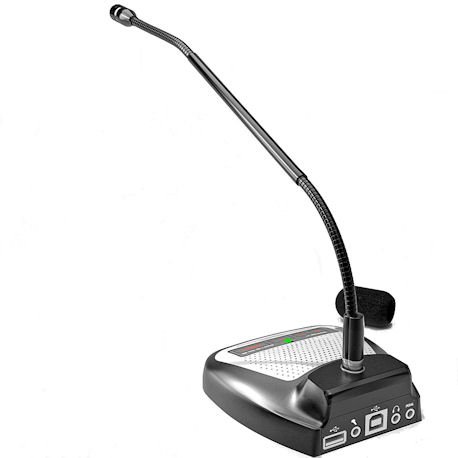
A purpose-built desktop dictation microphone with a built-in pre-amp, USB, and a far-field pickup that works from up to 50 cm. Tuned specifically for Dragon NaturallySpeaking and Whisper-class transcription engines.

Best for Knowledge workers and lawyers who use formal speech recognition software and want a dictation-specific microphone rather than a repurposed music mic.

Purpose-built for speech recognition with a far-field pickup pattern tuned for transcription enginesWorks from up to 50 cm, so you do not need to stay rigidly close to the micNo arm or stand needed; sits flat on the desk Not a music or broadcast mic; sounds clinical on calls compared to a condenser
No. 11 MXL AC-44 USB Microphone
4.2 Amazon

MXL AC-44 USB Microphone

The mic that gets the most mentions on developer blogs covering AI dictation on a budget. Omnidirectional cardioid pickup with a small desktop form factor and no arm required.

Best for Developers who want to try AI dictation for the first time without spending more than $40 on a microphone.

Lowest price entry point for a dedicated desktop voice mic over a laptop micCompact stand-mount design that takes up minimal desk spaceWidely cited as the first upgrade recommendation on developer dictation blogs Omnidirectional pickup captures room noise from all directions, reducing Whisper accuracy in noisy spaces
No. 12 Nuance PowerMic 4
4.2 Amazon

Nuance PowerMic 4

The standard issue dictation mic for Dragon Medical and Dragon Professional users, with a beamforming array, programmable buttons, and a USB-A plug-and-play design.

Best for Existing Dragon NaturallySpeaking or Dragon Medical users who need the officially supported hardware companion.

Official companion hardware for Dragon speech recognition softwareBeamforming array tuned for the Dragon engine's acoustic modelProgrammable function buttons for Dragon commands and workflow shortcuts Expensive for what is essentially a Dragon-specific peripheral; performs less well with Whisper-based tools

The method

How we chose

We evaluated each option on fit, build quality, daily usability, and value. Our top pick, Rode PodMic USB, earned the spot because the clear top pick for ai dictation. its room-noise rejection is the best argument for it when whisper accuracy matters. The comparison above highlights exactly who each pick is best for.

FAQ

Best USB Microphones for AI Dictation and Voice Coding: FAQ

What makes a microphone good for AI dictation and voice coding?+

A tight cardioid pickup pattern that rejects sound from the sides and rear matters most, because AI transcription models like Whisper perform better when ambient noise is low. A low self-noise floor helps too. USB-C is more reliable than legacy USB-A on modern MacBooks and Windows laptops. Condenser mics pick up more detail but require a quieter room; dynamic mics like the Rode PodMic USB reject background noise more aggressively.

Does microphone quality actually improve Whisper transcription accuracy?+

Yes, measurably. Whisper and similar models are trained on clean speech. When background noise, room reverb, or low-quality preamp hiss raises the noise floor, the model must work harder to distinguish phonemes and makes more errors. A directional USB microphone placed 6 to 12 inches from your mouth and aimed at your voice reduces that noise floor and produces cleaner input for the model.

Should I use a condenser or dynamic microphone for voice coding?+

Dynamic microphones like the Rode PodMic USB or Shure MV7+ are better choices for most home offices. They reject room reflections, keyboard noise, and HVAC rumble more aggressively than condensers. Condensers like the Blue Yeti X capture a wider frequency range and sound more detailed, but they also pick up more of the room. If you have acoustic treatment and a quiet space, a condenser excels. For typical home offices, a dynamic mic is more forgiving.

Can I use a dictation-specific microphone like the Philips SpeechMike with Whisper?+

Yes. Dedicated dictation microphones like the Philips SpeechMike Premium Air and Nuance PowerMic 4 are USB HID devices that appear as audio inputs to any app, including Whisper-based tools. They are tuned for speech rather than music, with pickup patterns and EQ curves optimized for the voice frequency range. The trade-off is that they cost more than general USB mics and the speech-focused tuning means they sound narrow on calls.

Do I need a boom arm and pop filter for AI dictation?+

A boom arm is highly recommended. Positioning the mic consistently 6 to 12 inches from your mouth at a slight downward angle gives the AI model a consistent, clean input versus the variable distance of a desk-stand mic. A pop filter or foam windscreen helps with plosives on condensers; dynamic mics are less sensitive to breath pops and can often get away without one. The investment is small and the consistency payoff for transcription is real.