AI Coding and Voice Statistics 2026: 28 Key Data Points
By FreqDeck · 8 min read · Updated June 2026
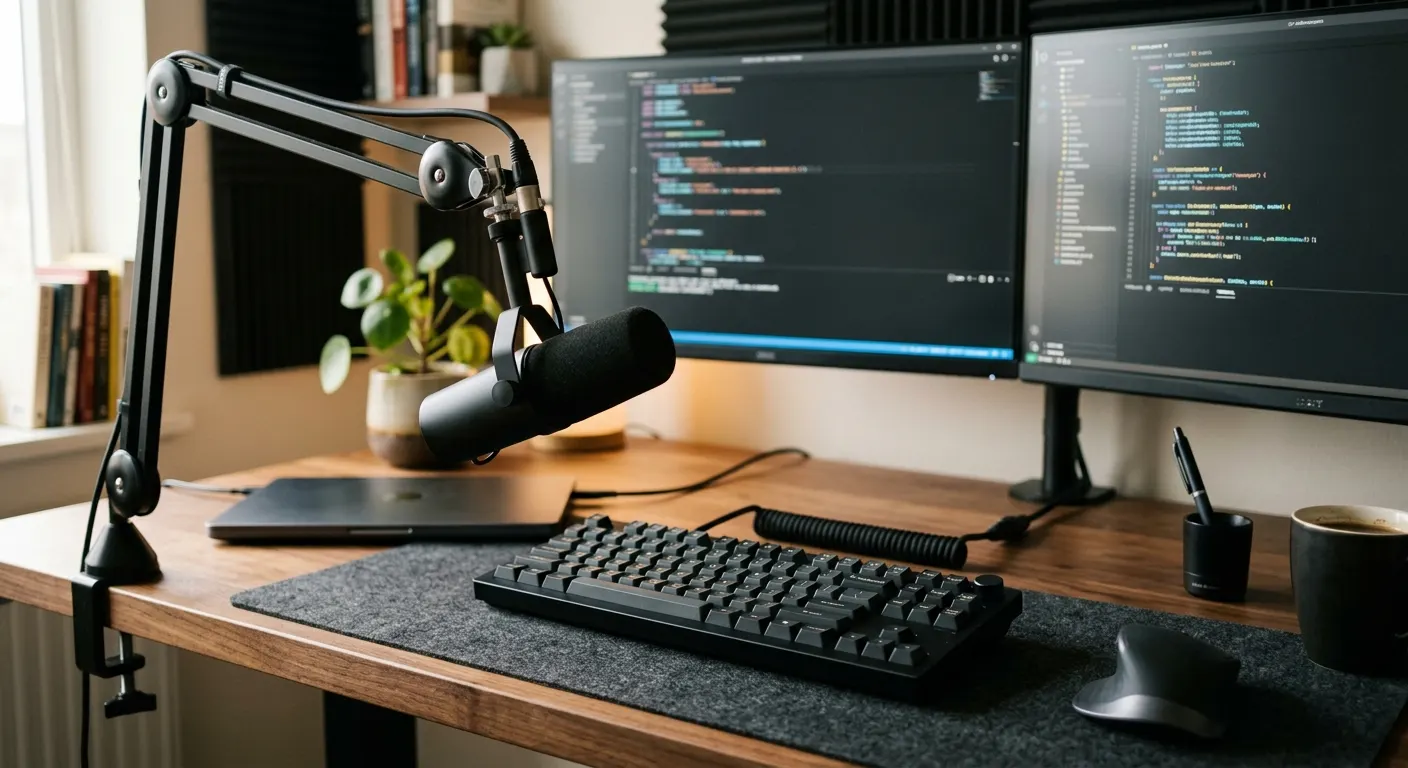
AI-assisted coding went from novelty to default in a couple of years, and voice is increasingly part of the workflow. This page collects 28 of the most useful, fully sourced statistics on AI in software development and the gear around it: how many developers use AI tools, the measured productivity gains, how accurate speech recognition has become, and how large the AI-code-tools, speech-recognition, microphone, and webcam markets are. Every figure below names its source and year so you can cite it with confidence. The data draws on the Stack Overflow Developer Survey, JetBrains, GitHub, MLCommons, and major market researchers.
Quick answer
About 84 percent of developers now use or plan to use AI tools, and 51 percent use them daily. GitHub Copilot has crossed 20 million all-time users, controlled studies show developers complete tasks 55 percent faster with it, and the AI code tools market is growing 26 percent a year while OpenAI Whisper reaches 97.93 percent word accuracy.
This guide contains affiliate links. FreqDeck may earn a commission at no cost to you.
How many developers use AI tools
AI adoption among developers is now the norm. The Stack Overflow Developer Survey found 62 percent of developers currently use AI tools in their development process in 2024, with 76 percent using or planning to use them. By the 2025 survey, that figure rose to 84 percent using or planning to use AI tools, and 51 percent of professional developers using them daily.
Adoption is broad across the industry. The JetBrains State of Developer Ecosystem 2025 survey found 85 percent of developers regularly use AI tools for coding and development, and 68 percent expect employers to require AI-tool proficiency in the near future.
Trust, however, lags usage. The 2025 Stack Overflow survey found only 3.1 percent of developers highly trust the accuracy of AI output, even as 82 percent of AI-tool users said they use AI mostly to write code.
The productivity case
The productivity benefit is both perceived and measured. The 2024 Stack Overflow survey found 81 percent of developers cite increased productivity as the top benefit of AI tools, and the JetBrains 2025 survey found nearly 90 percent of developers save at least one hour per week using AI.
A controlled GitHub study found developers using Copilot completed a coding task 55 percent faster than those without it, finishing in 1 hour 11 minutes versus 2 hours 41 minutes, and 73 percent of Copilot users reported staying in the flow while coding. In an enterprise study with Accenture, GitHub found an 84 percent increase in successful builds and that about 30 percent of Copilot suggestions were accepted.
Scale: Copilot and the developer base
The leading AI coding assistant operates at enormous scale. Per TechCrunch reporting on a Microsoft earnings call, GitHub Copilot has crossed 20 million all-time users, and 90 percent of the Fortune 100 use it.
The underlying developer population keeps expanding. GitHub Octoverse 2025 reported over 180 million developers working on GitHub, and 4.3 million AI-related repositories, nearly double the 2023 count.
The AI-code-tools and voice market
The market behind AI coding is growing very fast. Mordor Intelligence sizes the AI code tools market at 7.37 billion dollars in 2025, projecting 29.96 billion dollars by 2031 at a 26.23 percent compound annual growth rate.
Voice computing is growing too, and getting more accurate. MarketsandMarkets sizes the speech and voice recognition market at 9.66 billion dollars in 2025, projecting 23.11 billion by 2030 at a 19.1 percent CAGR. On accuracy, MLCommons reports OpenAI Whisper reaching 97.93 percent word accuracy on LibriSpeech, a word-error-rate reduction of over 72 percent versus the prior MLPerf reference ASR model. That accuracy is what makes dictation-driven coding viable with a clean mic like our Rode NT-USB Mini pick.

Rode NT-USB Mini
A compact studio condenser with a tight cardioid pattern, USB-C output, and an integrated pop filter built into the capsule housing. Excellent voice clarity for Whisper and voice-coding workflows.
The hardware: microphones, webcams, and ergonomics
Good input gear is its own growing market. Fortune Business Insights sizes the global microphone market at 4.32 billion dollars in 2024, projecting 5.81 billion by 2032 at a 4.0 percent CAGR. Precedence Research sizes the global webcams market at 8.54 billion dollars in 2024, projecting 17.18 billion by 2034 at a 7.24 percent CAGR.
There is a health reason to take voice input seriously, too. The CDC National Health Interview Survey reported that 9.0 percent of US men and 8.9 percent of US women aged 18 and older had a repetitive strain injury in the prior three months, a reminder of why reducing keyboard load matters for people who code all day.
Sources
Stack Overflow Developer Survey, 2024 and 2025. JetBrains State of Developer Ecosystem, 2025.
GitHub Research, Copilot productivity and Accenture enterprise studies, 2022 and 2024. TechCrunch, on a Microsoft earnings call, 2025. GitHub Octoverse, 2025.
Mordor Intelligence, Artificial Intelligence Code Tools Market, 2025. MarketsandMarkets, Speech and Voice Recognition Market, 2025. MLCommons, MLPerf Inference (Whisper), 2025.
Fortune Business Insights, Microphone Market, 2024. Precedence Research, Webcams Market, 2024. CDC National Health Interview Survey, via MMWR QuickStats, 2021.
Featured in this guide
Rode NT-USB Mini
A compact studio condenser with a tight cardioid pattern, USB-C output, and an integrated pop filter built into the capsule housing. Excellent voice clarity for Whisper and voice-coding workflows.
Related comparisons
Related roundups
FAQ
Frequently asked questions
How many developers use AI coding tools?+
The 2025 Stack Overflow Developer Survey found 84 percent of developers use or plan to use AI tools, with 51 percent of professional developers using them daily. JetBrains similarly found 85 percent of developers regularly use AI tools for coding and development.
Do AI coding tools actually make developers faster?+
Yes, by measured amounts. A controlled GitHub study found developers using Copilot completed a task 55 percent faster than those without it. In surveys, 81 percent of developers cite productivity as the top benefit, and nearly 90 percent say they save at least one hour per week using AI.
How accurate is speech-to-text for coding by voice?+
Very accurate in clean conditions. MLCommons reports OpenAI Whisper reaching 97.93 percent word accuracy on the LibriSpeech benchmark, a word-error-rate reduction of over 72 percent versus the prior reference model. A good microphone and quiet room matter more than the model at that point.
How big is the AI coding tools market?+
Mordor Intelligence sizes the AI code tools market at about 7.37 billion dollars in 2025, projected to reach 29.96 billion by 2031 at a 26.23 percent annual growth rate. The adjacent speech and voice recognition market is about 9.66 billion dollars and growing 19.1 percent a year.
How many people use GitHub Copilot?+
GitHub Copilot has crossed 20 million all-time users, and 90 percent of the Fortune 100 use it, per TechCrunch reporting on a Microsoft earnings call. The broader GitHub developer base exceeds 180 million, with 4.3 million AI-related repositories.